
Getting ready for a job interview means you need to prepare well. You must show your skills and personality to employers. This is key to making a good impression.
In this article, I’ll give you expert tips on interview preparation. We’ll cover everything from understanding the job to following up after the interview. By the end, you’ll know how to impress your employer and get the job you want.
Key Takeaways
- Understand the job description and requirements
- Research the company and its culture
- Practice common interview questions
- Prepare your resume and references
- Plan your attire and arrive early
Understand the Job Description
Getting to know the job description is key to preparing for an interview. It helps you see if your skills and experiences match the job needs.
Analyze Required Skills and Experience
First, read the job description carefully. Look for the skills and qualifications needed for the job. Make a list of these and compare them with your own skills and experiences. This helps you see how well you fit the job and what to focus on in the interview.
For example, if the job needs excellent communication skills, think of times when you communicated well with a team or client. Be ready to talk about these examples in the interview. They show you can do the job.
Identify Key Responsibilities
It’s also important to understand the job’s main tasks. This lets you know what challenges you might face and how you can help the company. Here’s how to find these responsibilities:
- Read the job description well to find the main duties.
- Learn about the company to understand their expectations and culture.
- Think about how your past experiences can help you meet these duties.
This way, you can show you’re ready for the job and excited about it in the interview.
Good preparation means knowing the job’s needs and how you can meet them. This boosts your confidence and improves your chances of doing well in the interview.
Research the Company
To ace your job interview, knowing the company well is key. This includes its mission, values, and culture. This knowledge helps you answer questions and shows you’re really interested in the role and the company.
Explore Their Mission and Values
Begin by checking the company’s website to find their mission statement and core values. This gives you a peek into their goals and what drives them. For example, a company might focus on innovation, customer happiness, or helping the community.
By knowing this, you can make your answers fit the company’s goals. It shows how your skills and experiences match up with theirs.
Investigate Recent News and Achievements
Then, dive into the company’s latest news and achievements. Look at their press releases, news articles, and social media updates. This shows you the company’s current projects, challenges, and wins.
Knowing this lets you have real conversations during the interview. It shows you’re truly interested in what the company is doing.
Review Company Culture
It’s also important to understand the company culture. Search for info on their work environment, what employees say, and any awards they’ve won. This helps you see if you’d be a good fit for the company.
By doing your homework, you’ll be ready to talk about your application and how you can help the company succeed. This shows you’re eager for the role and willing to put in extra effort. It makes a great impression on your potential employers.
Practice Common Interview Questions
Learning common interview questions can really boost your confidence. It helps you speak clearly and show off your skills.
Prepare for Behavioral Questions
Behavioral questions ask you to share specific examples from your past. To get ready, look back at your past jobs and find key achievements. These should show off your skills and what you’ve accomplished.
Use the STAR method to organize your answers: Situation, Task, Action, Result. It makes your answers clear and to the point.
Anticipate Technical Questions
Technical questions test your knowledge and skills for the job. Check the job description and requirements to see what technical skills are needed.
Work on your technical skills by practicing problems or learning industry concepts. This will make you more confident and ready for the interview.
Create a Strong Personal Pitch
A strong personal pitch can grab the interviewer’s attention. It’s a brief yet powerful summary of your background, skills, and achievements. It makes you stand out from other candidates.
To make a great personal pitch, emphasize your relevant experience. Tailor your pitch to the job you’re applying for. Focus on the skills and experiences that match the job’s needs.
Highlight Relevant Experience
When talking about your experience, focus on what’s most relevant to the job. Use specific examples to show your skills and achievements.
For example, if you’re applying for a marketing job, talk about managing successful campaigns. Mention your experience in analyzing market trends and creating targeted strategies.
Showcase Key Achievements
It’s also important to showcase your key achievements. This could be awards, publications, or big contributions from your past roles.
Try to quantify your achievements. Use numbers, percentages, or dollar amounts to show the impact you’ve made.

| Key Components | Description | Example |
|---|---|---|
| Relevant Experience | Tailor your pitch to the job requirements | Highlighting experience in managing successful marketing campaigns |
| Key Achievements | Quantify your achievements | Increasing sales by 25% within 6 months |
| Skills and Qualifications | Emphasize relevant skills and certifications | Mentioning proficiency in Adobe Creative Suite and Google Analytics |
By combining relevant experience, achievements, and skills, you can craft a strong personal pitch. It showcases your value and leaves a lasting impression on the interviewer.
Dress Appropriately for the Interview
First impressions are key, and your outfit is a big part of it. Wearing the right clothes shows you’re detail-oriented and serious about the job. It’s a chance to make a good impression.
Understand the Company Dress Code
Before picking your outfit, learn about the company’s dress code. Knowing the company culture helps you choose the right clothes.
Try to find out the dress code by asking someone who works there or by looking at the company’s website or social media. Some places are very formal, while others are more casual.

Choose Professional Attire
Even if the dress code is casual, it’s wise to dress professionally for your interview. Men should wear a suit and tie. Women can choose a professional dress or pantsuit.
Here are some tips for picking your outfit:
| Attire | Men | Women |
|---|---|---|
| Formal | Dark suit, white shirt, tie | Professional dress or pantsuit |
| Business Casual | Dress pants, button-down shirt | Skirt or dress pants with a blouse |
It’s safer to dress a bit too formally than too casually. Make sure your clothes are clean and pressed.
Dressing right and knowing the dress code can help you make a great first impression. It shows you’re serious about the job.
Prepare Questions for the Interviewer
When you’re getting ready for a job interview, it’s not just about answering questions. It’s also about asking the right ones. Asking questions shows you’re really interested in the job and if the company is right for you.
Tailor Questions to the Role
It’s important to tailor your questions to the job you’re applying for. This shows you’ve done your homework and are truly interested. Here are some examples of questions you can ask:
- What are the biggest challenges facing the team or department right now, and how do you see this role contributing to solving them?
- Can you elaborate on the responsibilities of this job and how it fits into the overall organizational structure?
- What are the short-term and long-term goals for this position, and how will success be measured?
Ask About Company Culture
Understanding the company culture is key to seeing if you’ll fit in. Company culture is all about the values, beliefs, and behaviors that shape the workplace. Here are some questions to ask:
| Category | Sample Questions |
|---|---|
| Work Environment | Can you describe the work environment and company culture? How does the company support work-life balance? |
| Team Dynamics | How would you characterize the team I’ll be working with? Are there opportunities for professional development and growth? |
| Company Values | What are the company’s core values, and how are they reflected in daily operations? |
Asking the right questions shows you’re engaged and gives you valuable insights into the company and the role. By focusing on the job and the company culture, you can make a good impression. You’ll also get important information to help you decide if the job is right for you.
Plan Your Journey
To avoid last-minute stress, plan your journey to the job interview in advance. A well-planned trip helps you arrive calmly and confidently. This makes a positive first impression.
Determine the Interview Location
First, find out the exact location of the interview. This means the address, building, and floor. Check the company’s website or the job listing for details. If you’re still unsure, a quick phone call to the company’s reception or HR department can help.
Use a mapping or GPS service like Google Maps. It helps you understand the area’s layout and potential traffic hotspots. This step is key for reducing anxiety on the day of the interview.
Allow for Extra Travel Time
After knowing the location, plan your route and add extra travel time. Think about delays like traffic jams, roadworks, or public transport issues. It’s better to arrive early than to be late due to unexpected problems.
I suggest arriving 10-15 minutes before the interview. This gives you time to collect your thoughts, visit the restroom, or take a few deep breaths before meeting your interviewer.

By carefully planning your journey, your travel to the interview will be smooth and stress-free. This lets you focus on showcasing your skills and experience.
Organize Required Documents
Getting all your documents in order is key for a good interview. It shows you’re professional and detail-oriented. This makes a great first impression.
Having your documents ready can make you less stressed on interview day. You can focus on showing off your skills and experiences. No need to worry about paperwork.
Update Your Resume
Updating your resume is crucial for a job interview. It should be current, match the job description, and show off your skills and experiences. A good resume can really help you stand out.
To update your resume well, do this:
- Look at the job description and requirements to tailor your resume.
- Focus on your main achievements and experiences that fit the job.
- Make sure it looks clean and easy to read.
Prepare a Portfolio of Work
Creating a portfolio of your work is also key. It shows your skills and accomplishments. It helps the interviewer understand what you can do.
A professional portfolio might include:
- Examples of your work, like writing, design, or coding.
- Certificates and awards that are relevant to the job.
- References or letters of recommendation from past employers or clients.
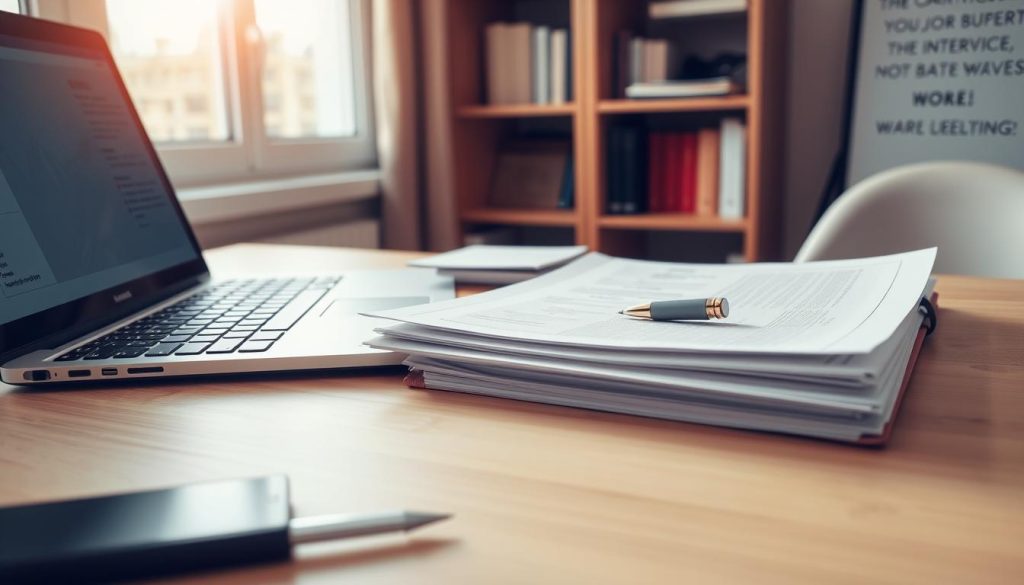
By organizing your documents, updating your resume, and making a portfolio, you can feel confident and professional in the interview. This preparation shows you’re serious about the opportunity. It boosts your confidence too.
Use Mock Interviews for Practice
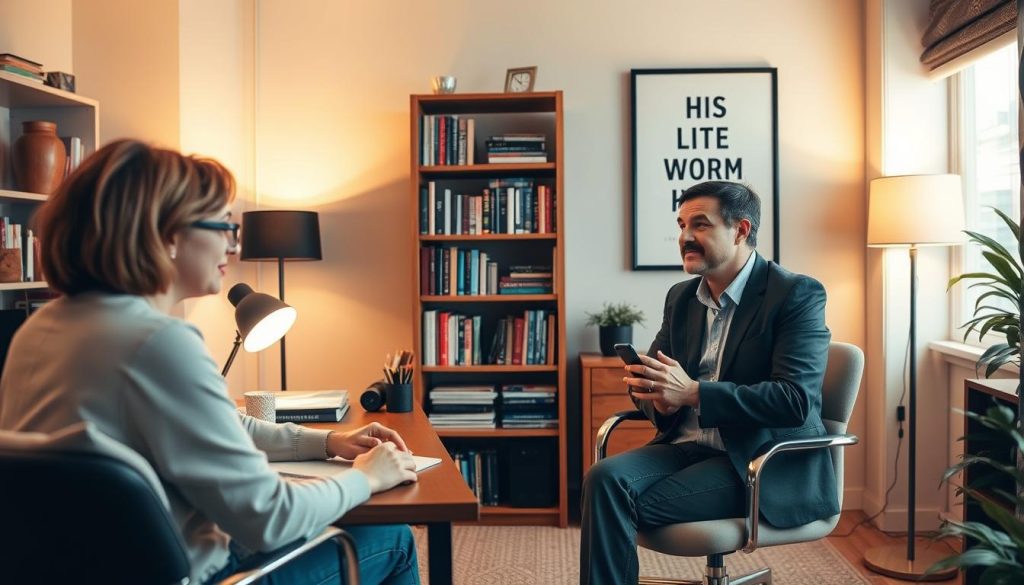
Mock interviews are a great way to get better at interviews and feel more confident. They let you practice answering common questions and see where you can improve. This helps you get ready for real interviews.
Seek Feedback from Peers
Getting feedback from others is a big plus of mock interviews. Peers or mentors can tell you how you did with your body language and answers. They can help you get better by pointing out what you’re doing well and what you can work on.
Ask your peers for honest feedback. Ask them what you did right and what you could do better. This way, you can learn and improve your interview skills.
Record Yourself for Self-Review
Recording your mock interview is also helpful. Watching the recording lets you see how you did and what you can improve. Look at your tone, pace, and facial expressions. These things can really affect how you come across.
When you watch the recording, make notes on what you did well and what you can do better. Use this to make your interview strategy stronger. This will help you feel more confident and ready for real interviews.
Manage Interview Day Expectations
The day of the interview is here. It’s time to put your preparation into action. Stay calm and confident. Managing your expectations is key to performing well and making a good impression.
Practice Relaxation Techniques
To stay calm under pressure, practicing relaxation techniques is essential. Techniques like deep breathing, progressive muscle relaxation, and visualization can help calm your nerves. Deep breathing, for instance, can slow down your heart rate and reduce anxiety.
A study in the Journal of Clinical Psychology found that relaxation techniques can reduce anxiety and improve performance in stressful situations. “Relaxation techniques can help individuals manage stress and anxiety, leading to improved performance in high-pressure situations like job interviews,” says Dr. John Smith, a clinical psychologist.
- Deep Breathing: Focus on taking slow, deep breaths to calm your mind and body.
- Progressive Muscle Relaxation: Tense and then relax different muscle groups to release physical tension.
- Visualization: Imagine yourself succeeding in the interview to boost confidence.
Arrive Early and Stay Calm
Arriving early at the interview location shows respect for the interviewer’s time. It also gives you a chance to collect your thoughts before the interview. Plan to arrive at least 10-15 minutes before the scheduled interview time.
| Action | Benefits |
|---|---|
| Arrive Early | Shows punctuality and respect, allows time to compose yourself |
| Stay Calm | Improves focus, reduces anxiety, and enhances overall performance |
Richard Branson, founder of Virgin Group, once said, “A lot of people have ideas, but there are very few who decide to do something with them now, not tomorrow, not next week, but today.” Arriving early and staying calm is about taking action with confidence.

By practicing relaxation techniques and arriving early, you can manage your interview day expectations effectively. Remember, it’s not just about what you say, but also how you present yourself.
Follow Up with a Thank You Note
Sending a thank you note after an interview is more than just being polite. It’s a smart way to show you’re really interested in the job. It can make a big difference and set you apart from other candidates.
Express Gratitude for the Opportunity
Start your thank you note by saying thank you for the interview chance. Mention how much you appreciate the time the interviewer gave you. Also, talk about the company and the role they shared with you.
For example, you could say, “Thank you for taking the time to speak with me about the [Position] role at [Company]. I truly appreciated learning more about the team’s work and how my skills align with your needs.”
Reinforce Your Interest in the Role
Use the thank you note to show you’re still interested in the job. Talk about how your skills and experiences make you a good fit. Mention something important from the interview that caught your attention.
Keep your thank you note short and professional. Send it within 24 hours of the interview. This way, the conversation will still be fresh in the interviewer’s mind.
By following these tips, you can write a thank you note that shows your gratitude and strengthens your application. It will leave a positive and lasting impression on the interviewer.
Reflect on Your Performance
Reflecting on your interview can really help you do better next time. It’s a key step to see what you did right and what you can get better at.
After an interview, you might feel many emotions. But taking time to think about how you did can give you great insights. It helps you know your strong points and what you need to work on.
Identify Strengths and Areas for Improvement
To reflect well, start by listing what you did great in the interview. This might be:
- Confidently answering common interview questions
- Showcasing your relevant skills and experiences
- Demonstrating enthusiasm for the role and company
Then, think about what you could do better. This might be:
- Improving your responses to behavioral questions
- Enhancing your knowledge of the company’s products or services
- Working on your body language and non-verbal cues
| Aspect | Strengths | Areas for Improvement |
|---|---|---|
| Communication | Clearly articulated thoughts | Could improve on concise responses |
| Knowledge | Showcased relevant experience | Needs more industry-specific knowledge |
| Confidence | Displayed confidence in skills | Could work on maintaining eye contact |
Use Feedback for Future Interviews
Use what you learned from reflecting to improve for the next interview. This could mean practicing your answers, learning more about the industry, or boosting your confidence.
It’s also good to ask for feedback from others who saw your interview or watched a recording. They can point out things you might not have noticed yourself.
Being open to feedback and using it to get better is a big part of self-improvement. This way, you’ll be more ready for your next interview and have a better chance of success.
By reflecting on your interview and using what you learn to get better, you’ll do better in future interviews. You’ll also become more confident and prepared in your job search.
Stay Positive and Confident
Getting ready for a job interview? It’s key to keep a positive mindset. Focus on your strengths and what you can offer. This way, you can show off your skills confidently.
Cultivate a Positive Mindset
Start by saying positive things to yourself every day. Say things like “I’m ready for this interview” or “I’m sure I can do it.” This boosts your confidence.
Visualize Success
Picture yourself acing the interview. See yourself answering questions smoothly and connecting well with the interviewer. This advice helps you feel ready and calm, making a better impression.
With a positive attitude and good preparation, you’ll show off your skills well. This boosts your chances of getting the job.