The largest orbital computer cluster is now open for use

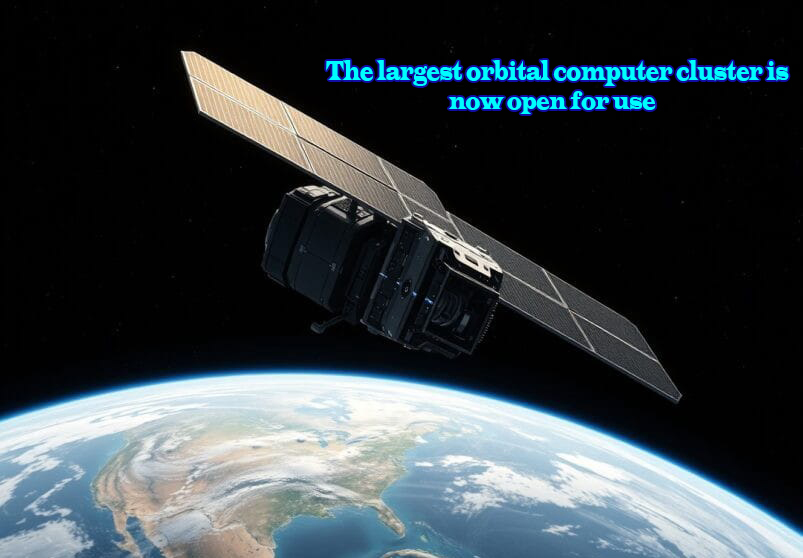
Despite significant buzz surrounding orbital data centers, the actual number of GPUs currently deployed in space remains quite low. However, as this capacity begins to increase, the practical, near-term commercial landscape for orbital computing is finally beginning to materialize.
The most significant compute cluster currently in space was deployed by the Canadian firm Kepler Communications this past January. It consists of approximately 40 Nvidia Orin edge processors distributed across 10 active satellites, which are interconnected via laser communication links.
Kepler Communications has expanded its client base to 18, announcing on Monday that Sophia Space is its latest partner. The startup plans to utilize Kepler’s satellite constellation to conduct software testing for its specialized orbital computer.
Experts anticipate that large-scale orbital data centers, such as those proposed by SpaceX and Blue Origin, will likely not emerge until the 2030s. In the interim, the immediate priority is to process data directly in orbit, a critical first step toward enhancing the performance of space-based sensors for both private sector and government applications.
Kepler Communications CEO Mina Mitry explained to TechCrunch that the company does not view itself as a data center provider, but rather as a foundational infrastructure layer for space-based applications. The firm aims to offer network services that support both orbiting satellites and aerial vehicles, such as drones and aircraft, operating in the atmosphere below.
Conversely, Sophia is engineering passively cooled space computers designed to address a critical hurdle for orbital data centers: preventing powerful processors from overheating without the need for the heavy, costly active-cooling systems that would otherwise be required.
Under this new partnership, Sophia will deploy its proprietary operating system onto Kepler’s satellites, aiming to configure and run it across six GPUs spanning two spacecraft. While such tasks are routine in terrestrial data centers, this marks a pioneering attempt in orbital computing. Validating this software in space serves as a critical risk-mitigation step for Sophia before its inaugural satellite launch, scheduled for late 2027.
For Kepler, this partnership serves as validation for its network’s utility. Currently, the company manages data either transmitted from Earth or gathered by its own hosted payloads. However, as the industry evolves, Kepler anticipates integrating with third-party satellites to offer expanded networking and processing capabilities.
Mitry notes that satellite operators are increasingly designing future assets with this model in mind, particularly to offload processing tasks from energy-intensive sensors like synthetic aperture radar (SAR). The U.S. military represents a significant customer, as it builds a missile defense network dependent on real-time threat detection and tracking. Notably, Kepler has already successfully demonstrated a space-to-air laser link for the U.S. government.
Edge processing—analyzing data at the point of collection to decrease latency—is the immediate value proposition for orbital data centers. This strategic focus distinguishes Sophia and Kepler from industry giants like SpaceX and Blue Origin, as well as startups such as Starcloud and Aetherflux, which are securing substantial funding to construct large-scale, traditional data center architectures in orbit.
Mitry told TechCrunch that because the priority is inference over training, the company prefers distributed GPUs instead of a single, powerful unit built for heavy training. “If a system uses kilowatts of power but only runs 10% of the time, it’s not very useful,” he noted. “Our GPUs, however, run at 100% utilization.”
Once these technologies are successfully validated in orbit, the potential applications could be transformative. Sophia CEO Rob DeMillo highlights that recent restrictions on data center development—such as a ban enacted last week in a Wisconsin city, alongside growing legislative pressure in Congress—could inadvertently make space-based alternatives a more compelling prospect. “There are no more data centers in that city,” DeMillo remarked. “Things are going to get interesting from here.”