Digital marketing has become one of the most useful skills for businesses, freelancers, students, and entrepreneurs. Whether you want to promote a small business, build a personal brand, get freelance clients, or grow an online store, understanding digital marketing can give you a major advantage.
The good news is that beginners do not need to master every marketing channel at once. A better approach is to understand the basics, choose the right strategies, practice consistently, and improve based on real results.
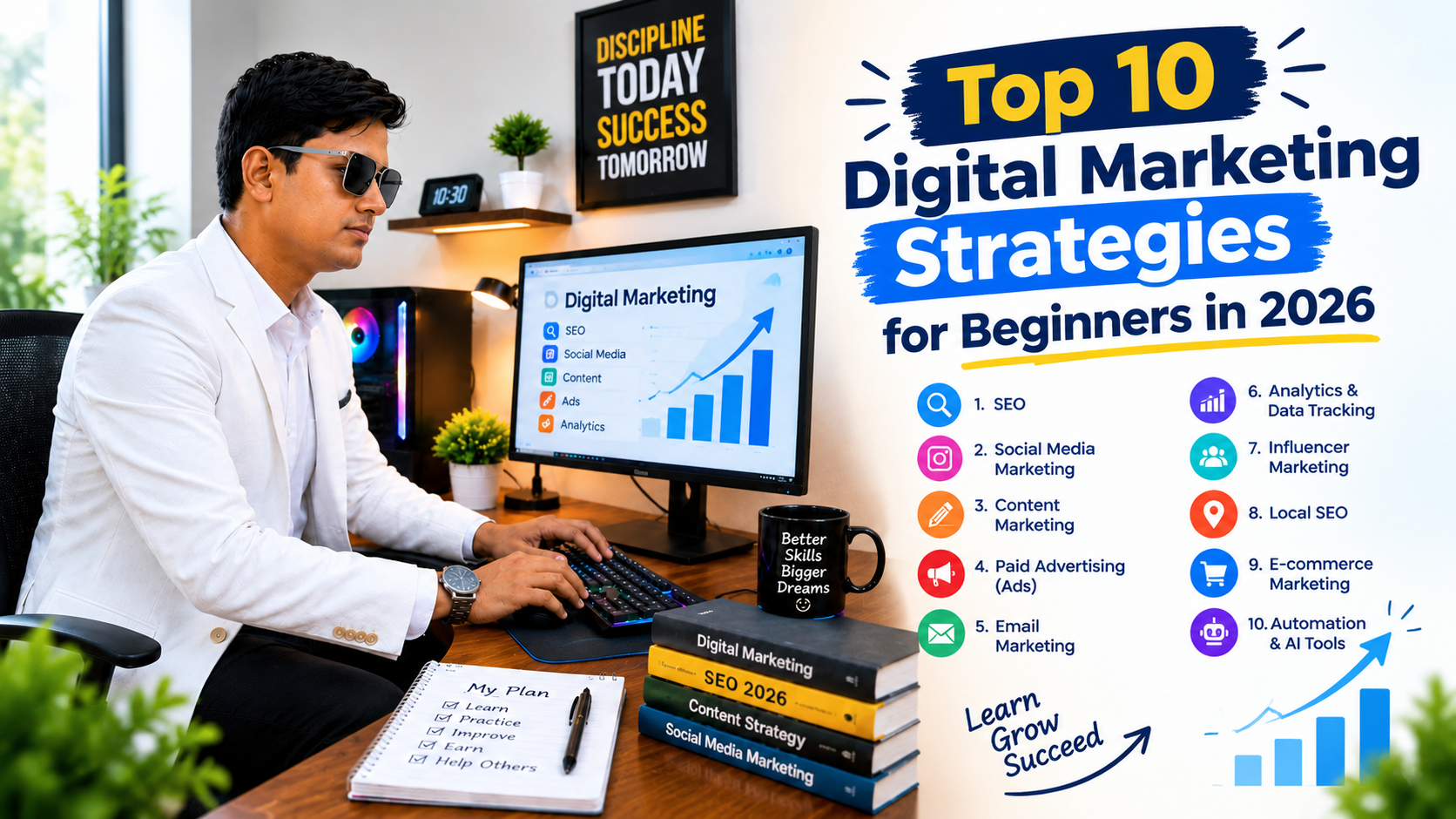
In this guide, we will explore 10 practical digital marketing strategies for beginners in 2026 and explain how you can start using them step by step.
What is digital marketing?
Digital marketing is the process of promoting a business, product, service, or personal brand through online channels.
These channels can include:
- Search engines
- Websites and blogs
- Social media
- Online advertising
- Video platforms
- Content marketing
- Mobile platforms
Unlike traditional advertising, digital marketing allows marketers to reach specific audiences and measure how people respond to campaigns. This makes it easier to test an idea, identify what works, and make improvements.
For beginners, the most important thing is not using every platform. It is learning why a particular channel is useful and how it supports a business goal.
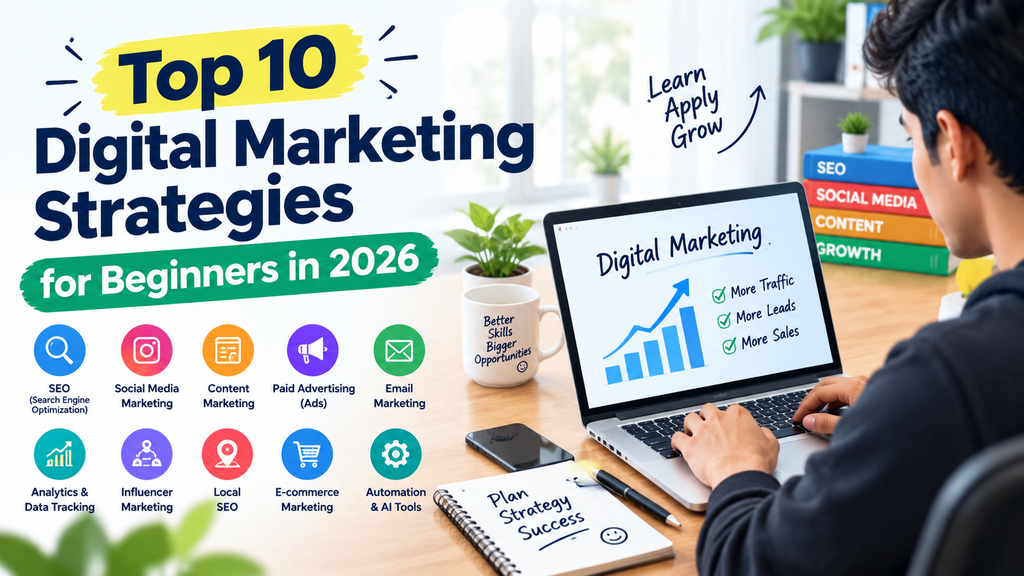
10 Digital Marketing Strategies for Beginners
1.Understand your target audience
Before creating content or running advertisements, you need to know who you want to reach. A target audience is the group of people most likely to be interested in your product or service.
For example, a business selling affordable women’s clothing may target:
- Young women
- College students
- Working professionals
- Online shoppers
- Customers interested in fashion
Try to understand their age, interests, problems, buying habits, and preferred online platforms.
Why it matters
If you understand your audience, your marketing messages become more relevant. Instead of creating content for everyone, you can create content specifically for the people who are most likely to become customers.
Beginner tip: Create a simple customer profile before starting your first campaign.
2.Build a Professional online presence
Your online presence is the foundation of your digital marketing efforts.
For many businesses, this starts with a simple website. Your website should clearly explain:
- What you offer
- Who you serve
- Why customers should choose you
- How customers can contact you
- How they can purchase your products or services
You should also maintain professional social media profiles where your potential customers spend time.
A website alone is not enough. Your business information, branding, contact details, images, and social profiles should provide a consistent experience.
Beginner tip
You don’t need an expensive website when you’re starting. Focus on making it:
Fast ,mobile -friendly ,and easy to navigate.
3.Learn the basics of SEO
Search Engine Optimization, commonly known as SEO, helps your website and content become easier for search engines to understand and discover.
For beginners, SEO can start with a few fundamental practices:
- Research relevant keywords
- Create useful content
- Write clear page titles
- Use descriptive headings
- Optimize images
- Improve website speed
- Add internal links
- Make content easy to read
For example, instead of writing a general article called “Marketing Tips,” you could target a more specific topic such as “Digital Marketing Tips for Small Businesses.”
The more closely your content matches what people are searching for, the better chance it has of attracting relevant visitors.
Beginner tip
Don’t focus only on high-volume keywords. Long-tail keywords can be easier for a new website to target.
4.Create helpful content
Content marketing is one of the most important parts of digital marketing.
Content can include:
- Blog posts
- Social media posts
- Videos
- Tutorials
- Infographics
- Case studies
- Guides
- Email newsletters
Good content should help your audience solve a problem, answer a question, learn something new, or make a better decision.
For example, a digital marketing beginner could create content such as:
5 SEO mistakes beginners should avoid.
Or
How to create your firs Facebook marketing camping.
The goal should not be to publish as much as possible. Instead, focus on creating content that provides genuine value.
5.Start social media marketing
Social media gives beginners an opportunity to build an audience without requiring a huge marketing budget.
Depending on your target audience, you might use platforms such as:
- YouTube
- TikTok
You don’t need to be active on every platform.
Choose one or two platforms where your target customers are most active and learn how they work.
What can you post?
You can share:
- Educational tips
- Product demonstrations
- Short videos
- Customer reviews
- Behind-the-scenes content
- Questions and polls
- Industry updates
- Helpful tutorials
Consistency is more important than posting randomly.
Beginner tip: Create a simple weekly content calendar so you know what to publish before the week starts.
6.Use video marketing
Video has become an important part of online marketing because people can understand visual information quickly.
Beginners can start with simple videos instead of expensive professional productions.
You can create:
- Short educational videos
- Product demonstrations
- How-to videos
- Customer testimonials
- Behind-the-scenes clips
- Quick marketing tips
Short-form videos can also help businesses introduce their products or ideas to new audiences.
You don’t need expensive equipment. A smartphone, good lighting, clear audio, and useful information can be enough to begin.
Beginner tip
Focus on the value of the video, not just its production quality.
7.Build a direct connection with Email
Social media followers are valuable, but you don’t fully control how often your posts reach them. Email gives you another way to stay connected with people who have already shown interest in your business.
You can use email campaigns to share:
- Helpful newsletters
- New products or services
- Special discounts
- Useful learning resources
- Follow-up messages
- Important business updates
Imagine you run a small online store. If they voluntarily subscribe to your email list, you can stay in touch and later introduce them to new products, useful recommendations, or selected offers.
Why Email deserves your attention
The real value of email isn’t simply sending promotional messages. It’s about developing familiarity and trust over time.
A useful email can bring someone back to your website, remind an existing customer about your brand, or introduce a new product to an interested audience.
Just remember that email lists should be built with proper permission, and your campaigns should follow the privacy and consent requirements that apply to your business and audience.
8. Let AI help, but keep the human touch
AI has quickly become part of the modern marketer’s toolkit. For someone just starting out, it can be especially useful when there is a lot to do and limited time available.
For example, AI can help you:
- Generate ideas when you’re stuck
- Explore possible content topics
- Create a rough campaign plan
- Organize research
- Improve a first draft
- Produce different versions of marketing messages
- Turn scattered ideas into a workable content plan
But there is an important rule: don’t let AI become your entire marketing strategy.
Two businesses can use the same AI tool and still produce completely different results. The difference comes from the research, experience, creativity, and understanding of the audience that humans bring to the process.
The smarter formula
Use AI for speed, then add your own thinking.
AI assistance + original ideas + real examples + research + human editing
This makes the final content more relevant and gives your brand a voice that feels less robotic.
9.Experiment with paid ads don’t gamble with your budget
Organic reach can take patience. Paid advertising can help a business reach a selected audience faster, but beginners should approach it as a testing process rather than simply spending money for visibility.
Depending on your goals, you might explore:
- Google Ads
- Meta advertising
- YouTube campaigns
- Display ads
- Sponsored social content
Before launching an advertisement, decide exactly what you want the campaign to achieve.
For example:
Goal → Website traffic
Goal → Lead generation
Goal → Product sales
Goal → Customer messages
Goal → Brand awareness
Start with a manageable budget and test one clear idea. Once you have enough data, you can decide whether the campaign deserves more investment.
A useful beginner rule
Don’t celebrate an advertisement simply because thousands of people viewed it.
Ask better questions:
Did people click?
Did they contact the business?
Did they buy something?
How much did each result cost?
These answers tell you far more about campaign performance than views alone.
10. Turn marketing data into better decisions
One of the biggest advantages of digital marketing is that your activities can be measured.
Instead of guessing what your audience likes, you can examine the available data and make better decisions.
Depending on the channel you’re using, you might monitor:
- Website visitors
- Click-through rates
- Engagement levels
- Leads generated
- Conversion rates
- Customer acquisition costs
- Advertising returns
- Email opens and clicks
Suppose you publish two different types of posts. One receives considerably more interaction. That doesn’t necessarily mean you should copy it immediately. First, look at the topic, format, timing, message, and audience response.
Then use what you learned to plan your next experiment.
That’s the mindset behind effective digital marketing:
Create → Test → Observe → Learn → Improve
Over time, small improvements can turn into a much stronger marketing strategy.
Digital marketing mistakes beginners should watch out for
Knowing the right strategies is only half the job. Beginners also need to recognize the habits that can slow their progress.
1.Trying to be everywhere
Opening accounts on every social platform may seem like a good idea, but maintaining them all can quickly become exhausting.
Choose the online platforms where your target audience is most active. Focus on those channels first, create useful content consistently, and expand to other platforms once you have built a strong foundation.
2. Chasing followers instead of results
Followers can increase your visibility, but they aren’t the final goal of most businesses. A smaller audience that trusts your brand can be more valuable than a huge audience that never interacts or purchases.
3. Treating SEO as an Afterthought
A social media post may disappear from attention quickly, while a useful search-optimized article can continue attracting visitors over a much longer period.
That’s why beginners should understand the fundamentals of SEO early.
4. Creating content without a direction
Publishing random posts makes it difficult for your audience to understand what your brand stands for. Choose a few core topics and create content around them consistently.
5. Increasing ad spending to quickly
A campaign that works with a small test budget may not automatically perform the same way at a much larger budget.
Increase spending gradually and keep checking the numbers.
6. Using competitors as templates
Competitor research is useful. Copying competitors is not. Look at what other businesses are doing to identify opportunities, then create content and campaigns that reflect your own brand and audience.
An 8 -week learning plan for digital marketing beginners
Becoming skilled in digital marketing takes time and regular practice. Instead of trying to master everything at once, follow a simple learning plan and improve your knowledge step by step.
week 1 — understand the landscape
Learn what SEO, content marketing, social media, email, paid advertising, and analytics actually do.
week 2—-explore SEO
Practice keyword research and learn how search-friendly content is organized.
week 3—practice social content
Create posts, captions, graphics, and short-form content for a real or imaginary business.
week 4 —work on content & video
Learn how to turn one idea into articles, videos, and social posts.
week 5 — discover Email marketing
Understand subscribers, newsletters, campaigns, and basic audience segmentation.
weed 6 — learn paid advertising
Study campaign objectives, audiences, budgets, ad creatives, and basic testing.
week 7— understand the numbers
Learn how to interpret traffic, engagement, conversions, and advertising performance.
week 8 — build something real
Create a small website, page, blog, or marketing project and apply everything you’ve learned.
The final step is especially important. Reading about digital marketing is useful, but doing the work teaches you things that theory alone cannot.
Personal advise:
Yes. Many free educational resources are available online. You can also gain valuable experience by creating your own small project and testing different marketing ideas.
There is no fixed timeline. You can understand the fundamentals within a few months with regular practice, but becoming highly capable takes longer because platforms, technologies, and audience behavior continue to evolve.
Yes, but thoughtfully. AI can help with research, brainstorming, planning, and repetitive tasks. Your own judgment, creativity, research, and editing should remain part of the process.
Absolutely. You don’t need a marketing degree to begin. Start with the fundamentals and practice your skills through a small website, social page, blog, or personal project.
Start by understanding your audience and the basic role of SEO, content marketing, and social media. Once these foundations are clear, move toward email, advertising, analytics, and AI tools.
Final thoughts
Starting digital marketing can feel confusing because there are so many tools, platforms, and techniques competing for your attention.
You don’t need to learn them all immediately.
Begin with the basics. Learn who your audience is, create a strong online presence, understand SEO, produce useful content, and become comfortable with social media. From there, gradually explore email, paid advertising, analytics, and AI-powered tools.
Technology will continue to change throughout 2026 and beyond. The marketers who adapt best won’t necessarily be the people who use the most tools. They will be the ones who understand their audience, test their ideas, learn from data, and communicate with people effectively.
So don’t wait until you know everything.
Learn one skill. Practice it. Measure what happens. Improve it. Then move to the next skill.
That’s a much more realistic way for a beginner to build digital marketing expertise.