According to LinkedIn, AI is not responsible for the decline in staffing… yet

During an interview at the Semafor World Economy Summit this week, LinkedIn’s Chief Global Affairs and Legal Officer, Blake Lawit, confirmed a significant cooling in the labor market. According to LinkedIn’s internal data, hiring rates have seen a steady decline of approximately 20% since 2022.
Despite the cooling market, Lawit was quick to dismiss the notion that AI is responsible for the slowdown. Drawing on LinkedIn’s “economic graph”—a real-time dataset of over a billion members—he explained that the company has actively searched for signs of AI-driven job displacement. “Honestly, we haven’t seen it,” Lawit stated, noting that despite the intense public curiosity, the data doesn’t currently support the idea that AI is impacting overall employment levels. According to LinkedIn, AI is not responsible for the decline in staffing… yet
Instead, the official suggested that interest rate increases are more closely linked to reduced hiring.
In areas where everyone is talking about AI, such as various industries—whether it’s customer service, administration, or marketing—we haven’t seen the expected impact. All of these areas would have seen the impact of AI,” Lowitt added. According to LinkedIn, AI is not responsible for the decline in staffing… yet
Lawit emphasized that while hiring has slowed, it hasn’t plummeted disproportionately in AI-sensitive fields. “Yes, hiring’s down, but not down more,” he clarified. Furthermore, LinkedIn’s data suggests that the downturn hasn’t uniquely penalized the youngest demographic; the decline in hiring for college-aged adults entering the workforce is consistent with the rates seen for mid-career and senior professionals.
Still, he did not rule out the possibility of the situation changing. “That doesn’t mean it won’t happen in the future, but not yet.”
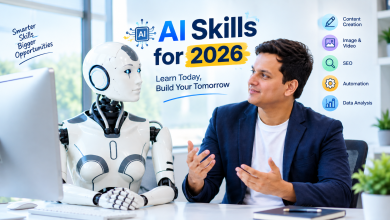
While the headcount remains stable, Lawit issued a significant warning regarding the nature of the work itself. He noted that the skills required for the average role have already shifted by 25% over the last few years. With the continued integration of AI, LinkedIn projects that this transformation will accelerate dramatically, reaching a 70% shift in required skills by 2030.
Is AI really causing fewer jobs
AI has become one of the biggest topics in the employment market. Businesses are using AI to automate repetitive tasks, analyze information, create content, support customers, and improve productivity.
This has naturally created concerns about job losses. Many workers are asking whether companies will eventually replace employees with AI systems. According to LinkedIn, AI is not responsible for the decline in staffing… yet
LinkedIn’s data suggests that the current hiring slowdown cannot simply be explained by AI. Economic uncertainty, changing business conditions, and other market factors are also affecting recruitment.
That means blaming AI alone for fewer job openings would give an incomplete picture of what is happening in the labor market. According to LinkedIn, AI is not responsible for the decline in staffing… yet
AI is still changing the job market
Even if AI is not currently the main cause of slower hiring, its influence is becoming harder to ignore.
Companies are increasingly looking for workers who can use AI effectively. Instead of completely replacing employees, many businesses may use AI to help existing workers complete tasks faster.
For example, a marketing professional can use AI to generate ideas, analyze customer data, or create an initial draft. A programmer can use AI coding assistants to speed up development. A customer-service employee can use AI to find information and respond to routine questions. According to LinkedIn, AI is not responsible for the decline in staffing… yet
This means the important question may not be whether AI will eliminate every job. A more useful question is how AI will change the skills required for those jobs.
Skills could become more important than job titles
One of the biggest changes AI may bring to the workplace is a shift in the skills employers value.
Some traditional tasks may become automated, while new responsibilities will appear. Workers who understand how to work alongside AI could have an advantage over people who ignore the technology.
Skills such as critical thinking, creativity, communication, problem-solving, data analysis, and AI literacy may become increasingly valuable. According to LinkedIn, AI is not responsible for the decline in staffing… yet
This could create a workplace where employees are not competing directly against AI. Instead, they are competing with other workers who know how to use AI more effectively.
Why hiring is slowing down
The job market is influenced by many factors beyond technology.
Companies may reduce hiring when they face economic uncertainty, higher operating costs, weaker consumer demand, or pressure to improve profitability. Businesses can also become more selective when filling new positions.
Because of this, a reduction in job openings does not automatically mean that AI has replaced those workers.
AI may be one part of a larger transformation, but it is difficult to separate its effect from other economic and business conditions.
What could happen next?
The current situation may change as AI becomes more widely adopted.
Companies are still experimenting with AI and discovering where it can provide the most value. As these technologies become more capable, some tasks could require fewer human hours.
At the same time, AI could create demand for new roles involving AI implementation, data management, model evaluation, cybersecurity, automation, and AI strategy. According to LinkedIn, AI is not responsible for the decline in staffing… yet
So the future may not simply be a story of “AI takes jobs.” Instead, the workforce could experience a combination of job transformation, new opportunities, and changes in the skills required for existing careers.
What workers can do now
Workers do not necessarily need to become AI engineers to prepare for this changing environment.
Learning how to use popular AI tools can be a practical starting point. Professionals can also focus on improving skills that AI cannot easily replace, such as communication, leadership, creativity, decision-making, and understanding customers. According to LinkedIn, AI is not responsible for the decline in staffing… yet
Students and job seekers can also begin exploring AI-related tools within their chosen industries.
The goal should not be to panic about AI. The better approach is to understand how the technology works and learn how it can improve your own productivity.
Final thoughts
LinkedIn’s perspective challenges the idea that AI is already the main reason behind the decline in hiring.
The current hiring slowdown appears to have multiple causes, and AI is only one part of a much bigger transformation taking place in the workplace. According to LinkedIn, AI is not responsible for the decline in staffing… yet
However, that does not mean workers should ignore AI. As businesses continue adopting artificial intelligence, the skills employers want are likely to change.
The biggest advantage in the future may belong to people who can combine human skills with AI tools rather than treating them as competitors. According to LinkedIn, AI is not responsible for the decline in staffing… yet