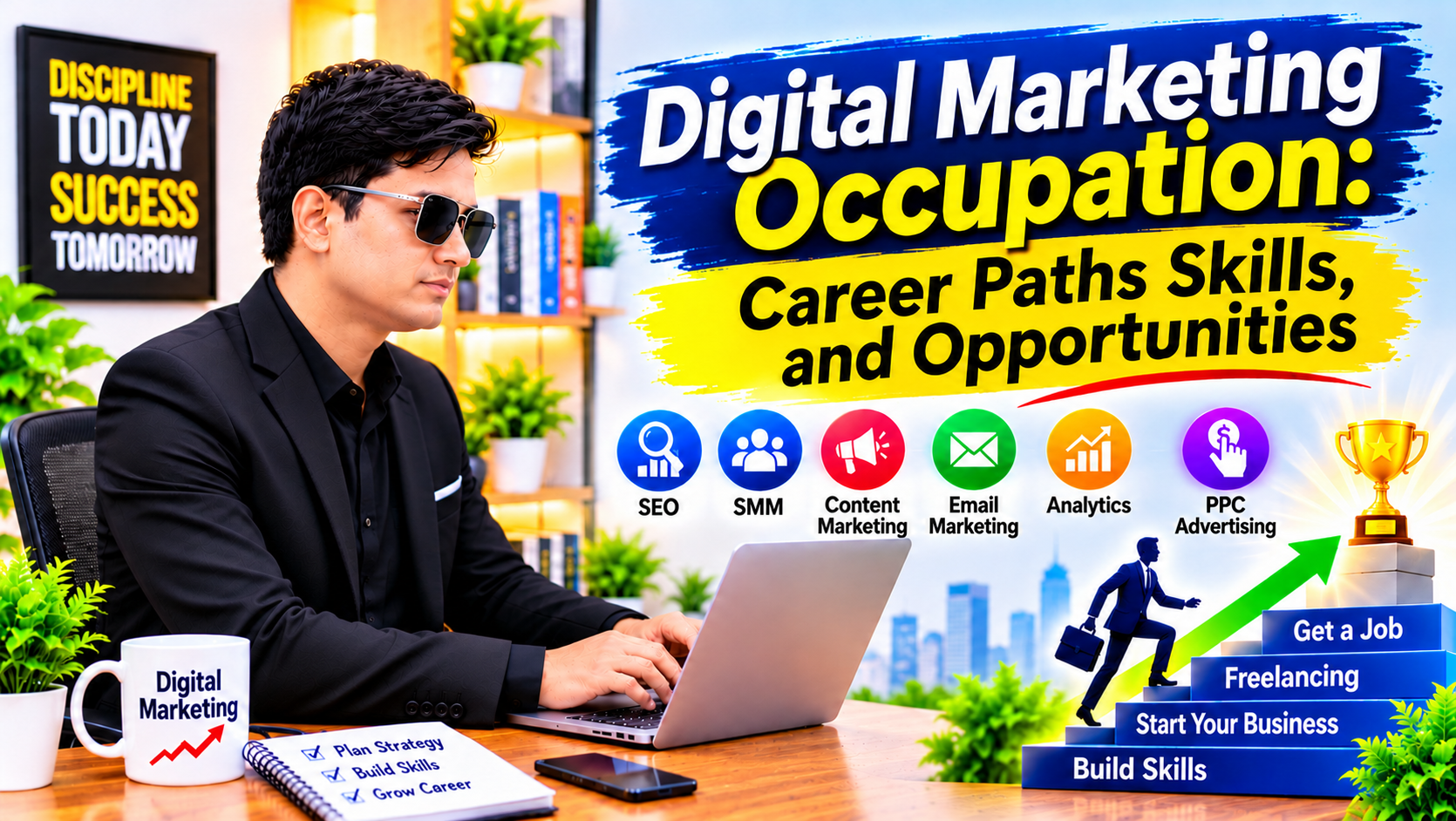
Digital Marketing Occupation: Career Paths Skills, and Opportunities

Introduction
The internet has changed how people communicate, shop, learn, and make purchasing decisions. Businesses now depend on websites, search engines, social media platforms, and online advertising to reach customers. This change has created a wide range of employment opportunities for people interested in technology, communication, creativity, and business development. Digital Marketing Occupation Career Paths Skills, and Opportunities .
A digital marketing occupation involves using online platforms and marketing techniques to promote products, services, organizations, or personal brands. Professionals in this field help businesses understand their audiences, create useful content, improve online visibility, and measure the performance of promotional activities.
Unlike some traditional careers that require working in a single specialized area, digital marketing offers several professional directions. Someone who enjoys writing may become a content marketer, while a person interested in data and research may choose SEO or marketing analytics.
Understanding these career options, their responsibilities, and the skills they require can help beginners choose a suitable path. Digital Marketing Occupation Career Paths Skills, and Opportunities .
What is a digital marketing occupation?
A digital marketing occupation refers to professional work related to promoting businesses and communicating with audiences through digital channels.
People working in this field use different tools and strategies to attract potential customers, share information, build brand recognition, and support business objectives.
Their daily responsibilities depend on their job positions. For example, an SEO specialist focuses on improving website visibility in search results, while a social media manager plans online content and manages audience engagement.
Some professionals work independently as freelancers, others join marketing agencies, and many work within the marketing departments of established companies.
The occupation combines creative thinking with practical business knowledge. Professionals need to understand customer interests, communicate clearly, use digital tools, and evaluate whether their activities are producing useful results.
Popular career options in digital marketing
Digital marketing is not a single job title. It includes several specialized roles, each requiring a different combination of knowledge and abilities. Digital Marketing Occupation Career Paths Skills, and Opportunities .
1. Digital marketing executive
A digital marketing executive supports the planning and implementation of online promotional activities.
Typical responsibilities include preparing marketing content, assisting with advertising campaigns, managing social media activities, researching competitors, and monitoring campaign performance.
This position can provide beginners with exposure to different areas of online marketing before they decide to specialize. Digital Marketing Occupation Career Paths Skills, and Opportunities .
2.Search engine optimization (SEO) Specialist

The role involves researching search terms, examining website structure, optimizing page content, identifying technical issues, and evaluating organic search performance.
SEO professionals also need to understand search intent. Knowing what people actually want when they enter a search query helps them create more relevant website content.
3.Social media manager
A social media manager handles a brand’s communication and content activities across platforms such as Facebook, Instagram, LinkedIn, and TikTok.
The work may include developing content schedules, preparing captions, coordinating creative designs, reviewing engagement, and communicating with audiences.
A successful social media manager understands that each platform has different content formats and audience expectations. Digital Marketing Occupation Career Paths Skills, and Opportunities .
4.Content writer and content strategist
Content professionals create information that helps audiences understand topics, explore solutions, or make decisions.
Their work may include blog articles, website pages, product descriptions, social media captions, email newsletters, and educational materials.
A content strategist takes a broader role by planning what should be published, who the content should serve, and how it supports the organization’s objectives.
Research, originality, readability, and factual accuracy are important qualities in this career. Digital Marketing Occupation Career Paths Skills, and Opportunities .
5.PPC and paid advertising specialist
A PPC specialist manages paid promotional campaigns on platforms such as Google Ads and Meta Ads.
Responsibilities can include selecting campaign objectives, preparing advertisements, researching audiences, managing budgets, and studying performance reports.
The professional must understand how advertising costs relate to business outcomes. Getting clicks is not enough if the campaign fails to attract relevant customers or generate valuable actions.
6.Email marketing specialist
An email marketing specialist develops communication campaigns for subscribers and customers. Digital Marketing Occupation Career Paths Skills, and Opportunities .
This role may involve creating newsletters, organizing subscriber groups, writing promotional messages, setting up automated workflows, and examining email performance.
Good email marketing requires clear communication and respect for subscriber preferences. Sending frequent, irrelevant messages can damage customer trust.
7.Graphic designer and creative specialist
Visual communication plays an important part in digital promotion. Digital Marketing Occupation Career Paths Skills, and Opportunities .
Graphic designers prepare advertisements, social media graphics, banners, promotional materials, and other visual assets. Some also work with short-form video, motion graphics, and brand identity.
They need to understand design principles, visual consistency, typography, and the requirements of different digital platforms.
8.Digital marketing analyst
A digital marketing analyst studies campaign and website data to help businesses understand customer behavior. Digital Marketing Occupation Career Paths Skills, and Opportunities .
The work may involve examining traffic sources, conversion rates, advertising costs, engagement patterns, and customer acquisition performance.
Analysts turn collected information into practical recommendations that help marketing teams improve their decisions.
Essential skills for a digital marketing career

Getting into digital marketing requires more than knowing how to use social media. Professionals need a combination of technical knowledge, communication abilities, and problem-solving skills.
1.Communication skills
Marketers communicate with customers, colleagues, clients, and business owners. They need to explain ideas clearly through written and spoken language. Digital Marketing Occupation Career Paths Skills, and Opportunities .
Good communication is especially useful when preparing advertisements, writing website content, presenting campaign reports, or responding to customer questions.
2. Research and analytical thinking
Marketing decisions should be based on information rather than assumptions.
Professionals need to research audiences, understand competitors, examine search trends, and interpret campaign data. Digital Marketing Occupation Career Paths Skills, and Opportunities .
Analytical thinking helps identify why a campaign is performing well or what might be preventing it from reaching its objectives.
3.content creation
The ability to produce helpful and engaging content is valuable across many marketing positions.
Depending on the role, content creation may involve writing articles, designing graphics, recording videos, preparing captions, or developing email messages. Digital Marketing Occupation Career Paths Skills, and Opportunities .
The goal should be to communicate meaningful information instead of publishing material simply to remain active online.
4.Technical knowledge
Digital marketers regularly use different online tools and platforms.
Useful technical knowledge includes website management, SEO fundamentals, advertising platforms, analytics systems, content management systems, and basic marketing automation.
The required knowledge depends on the chosen specialization.
5. Time management
Marketing activities often involve multiple deadlines, content schedules, campaigns, and reporting tasks. Digital Marketing Occupation Career Paths Skills, and Opportunities .
Organizing work properly helps professionals complete projects on time and maintain consistent communication with clients or team members.
6.Adaptability and continuous learning
Digital platforms, customer expectations, and marketing technologies change regularly.
Professionals must be willing to learn new methods, test suitable tools, and update their knowledge when existing strategies become less effective.
Educational requirements for digital marketing jobs
There is no single educational route that applies to every digital marketing occupation.
Some employers prefer candidates with degrees in marketing, business administration, communication, information technology, or related subjects. Other employers place greater importance on practical skills, relevant experience, and evidence of completed projects.
Beginners can build their knowledge through online courses, professional training, tutorials, books, and hands-on practice. Digital Marketing Occupation Career Paths Skills, and Opportunities .
Industry certifications may also help demonstrate familiarity with particular platforms or marketing subjects. However, a certificate alone does not guarantee employment.
A strong portfolio can be especially useful. It allows candidates to show what they can actually do rather than relying only on descriptions of their skills.
How to start a career in digital marketing

Starting a digital marketing career becomes easier when learning is organized around practical goals.
Step 1: Understand the main marketing concepts
Begin by learning how online promotion works. Study customer research, branding, search engines, social media marketing, advertising, and content strategy. Digital Marketing Occupation Career Paths Skills, and Opportunities .
Understanding the purpose of each area will help you select a specialization later.
Step 2: Choose one skill to develop first
Trying to master every digital marketing service at the same time can make learning confusing.
Start with one area, such as SEO, social media management, content writing, or paid advertising. Build a foundation before moving into more advanced subjects. Digital Marketing Occupation Career Paths Skills, and Opportunities .
Step 3: Practice with realistic projects
Practical experience helps transform theoretical knowledge into usable skills.
For example, you can create a sample business page, develop a weekly content calendar, research keywords for a website, or prepare a demonstration advertising campaign.
Clearly identify practice projects as sample work rather than claiming they produced results for real clients. Digital Marketing Occupation Career Paths Skills, and Opportunities .
Step 4: Build a Professional portfolio
A portfolio should demonstrate your abilities through examples.
You might include:
- Sample SEO keyword research.
- Optimized website content.
- Social media post designs.
- A sample advertising strategy.
- A content calendar.
- Basic campaign performance reports.
Organize the work so potential employers or clients can easily understand your contribution.
Step 5: Apply for entry level opportunities
Look for internships, junior marketing positions, agency opportunities, and freelance projects.
Early professional experience can help you understand client expectations, workplace communication, project management, and practical marketing challenges. Digital Marketing Occupation Career Paths Skills, and Opportunities .
Step 6: Continue Improving your knowledge
After gaining basic experience, explore advanced topics related to your specialization.
Someone starting in SEO can gradually explore website performance, technical optimization, and search data, while social media marketers can expand their expertise in advertising management and strategic content development.
Freelancing vs. full time employment
Digital marketing professionals can choose different working arrangements depending on their goals and circumstances.
Freelancing: Freelancers provide services to individual clients or businesses, often working remotely. They may manage several projects and organize their own schedules. However, finding clients, negotiating payments, and maintaining a steady workload require additional effort.
Full-Time Employment: Employees work within a company or agency and usually follow an established schedule and organizational structure. This arrangement may provide opportunities for teamwork, professional development, and consistent work responsibilities.
Remote Employment: Some organizations hire digital marketers who work from home or another location. Remote professionals still need reliable communication, time management, and the ability to meet project deadlines.
Each arrangement has different advantages. The best option depends on personal preferences, experience, financial expectations, and available opportunities.
Salary and career growth in digital marketing
Earnings in digital marketing are not fixed. They depend on professional experience, specialization, location, employer, industry, and the complexity of assigned responsibilities.
An entry-level social media assistant may have different earning opportunities from an experienced advertising strategist or marketing analyst.
Professionals can improve their career prospects by developing specialized knowledge, completing successful projects, communicating effectively, and demonstrating their ability to solve business problems. Digital Marketing Occupation Career Paths Skills, and Opportunities .
Career progression may lead to positions such as SEO manager, performance marketing manager, content strategist, digital marketing consultant, or marketing director.
Freelancers may also increase their service rates as they gain experience and develop a strong record of reliable work.
Rather than focusing only on salary expectations, beginners should concentrate on building useful skills and gaining practical experience.
Tools commonly used by digital marketing professionals
Digital marketers rely on a variety of software and online platforms to research audiences, develop marketing materials, communicate with customers, and evaluate campaign results.
Some commonly used tools include:
- Google Analytics 4: Helps examine website activity and user interactions.
- Google Search Console: Helps website owners monitor how their pages appear in Google search results, identify indexing problems, and understand organic search traffic.
- Google Ads: Supports paid advertising campaigns on Google’s advertising network.
- Meta Ads Manager: Helps businesses create and manage advertising across Meta platforms.
- Canva: Supports graphic design and the creation of visual marketing materials.
- WordPress: Provides a flexible platform for building websites, publishing articles, organizing pages, and managing digital content without requiring advanced programming knowledge.
- Mailchimp: Provides tools for email marketing and subscriber communication.
- Google Trends: Enables marketers to investigate popular search topics, compare keyword interest, and identify how people’s search behavior changes over different periods.
Knowing how to operate a digital marketing tool is only part of the learning process; understanding its practical purpose and choosing the right situation to apply it are equally essential.
Challenges in a digital marketing occupation
Like other professional fields, digital marketing involves challenges that require patience and continuous improvement.
Competition for jobs and freelance projects can be strong, particularly for beginners without a portfolio.
Platform updates may also change how content is distributed or how advertising campaigns perform. Professionals need to review their methods rather than depend on outdated techniques.
Another challenge is managing expectations. Marketing does not always generate immediate sales, and results can depend on product quality, pricing, competition, website experience, and customer demand.
Maintaining accurate information and responsible communication is also essential. Misleading advertisements or copied content can harm a business’s reputation.
Developing practical skills and learning from real projects can help professionals handle these challenges more effectively.
Future opportunities in digital marketing
The demand for digital communication and online business services continues to create opportunities for skilled marketing professionals.
Artificial intelligence is changing how marketers research topics, organize information, analyze data, and prepare initial content drafts. Automation is also helping businesses manage repetitive communication and reporting tasks.
At the same time, human abilities remain important. Creativity, strategic thinking, ethical judgment, original research, and understanding customer needs cannot be replaced simply by using software.
Future opportunities may grow in areas such as performance marketing, marketing analytics, marketing automation, search optimization, video strategy, and customer experience.
Professionals who combine technical knowledge with communication and problem-solving abilities can prepare themselves for changes in the industry. Digital Marketing Occupation Career Paths Skills, and Opportunities .
Conclusion
A digital marketing occupation offers different career possibilities for people interested in online business, communication, technology, and creative work.
From SEO specialists and content writers to social media managers and advertising professionals, each role contributes to a different part of the marketing process. Digital Marketing Occupation Career Paths Skills, and Opportunities .
Starting a career does not require mastering every subject at once. A more practical approach is to select one area, learn its fundamentals, complete sample projects, and gradually develop a professional portfolio.
With consistent learning, practical experience, and a willingness to adapt, beginners can build a foundation for long-term growth in the digital marketing industry.