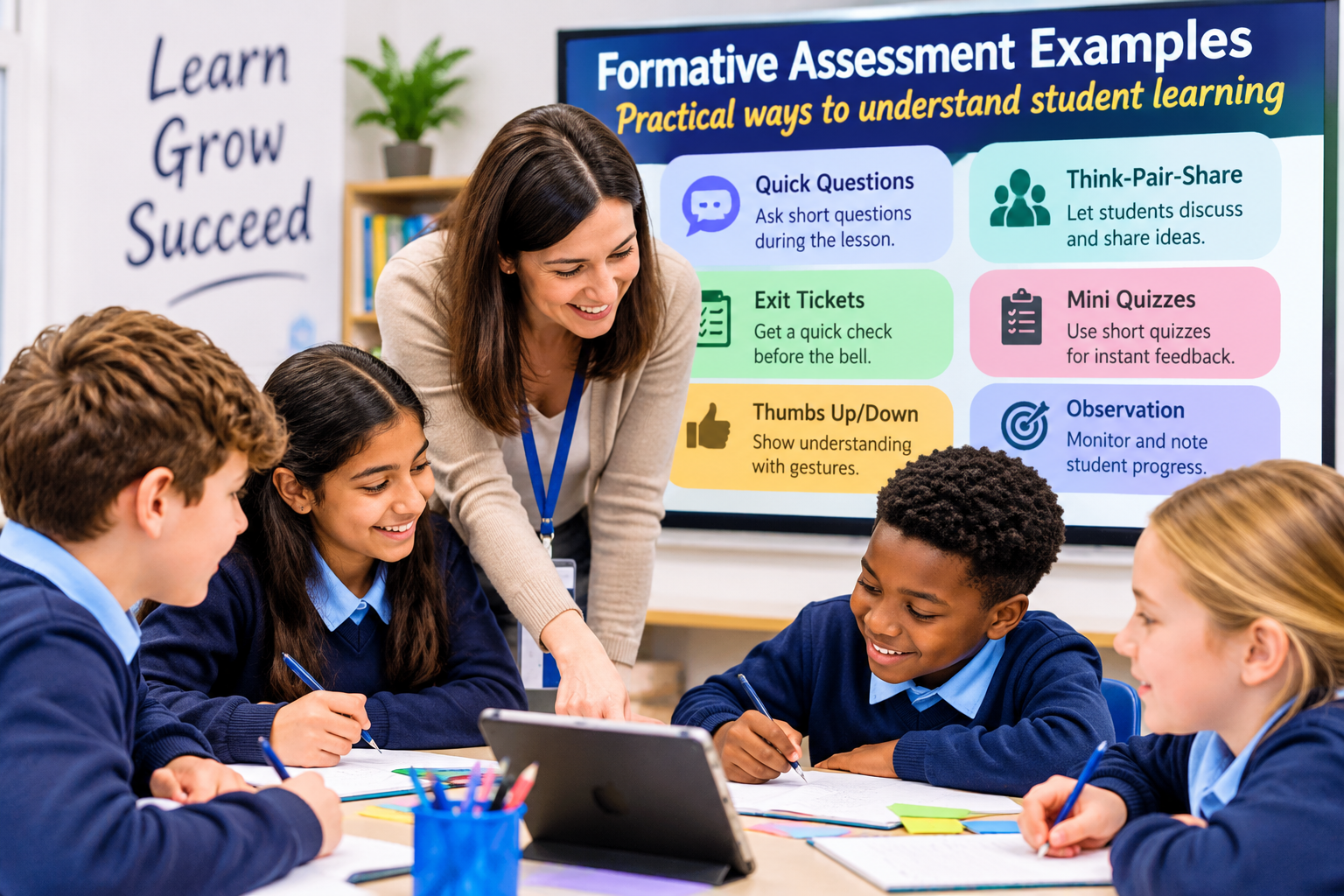
Formative Assessment Examples: Practical ways to understand student learning

Introduction
A classroom can be full of activity without every student necessarily understanding the lesson. Some learners follow instructions confidently, while others remain confused but hesitate to ask questions. Teachers may not discover these differences until homework, assignments, or final examinations reveal a problem.
This creates an important challenge in education: how can teachers recognize learning difficulties while there is still enough time to address them? Formative Assessment Examples Practical ways to understand student learning .
Formative assessment offers a practical approach. It allows educators to gather information about student understanding during everyday teaching rather than depending entirely on end-of-term examinations. The information collected can help teachers identify misconceptions, reconsider explanations, and decide which topics require additional attention.
For example, after introducing a lesson about percentages, a mathematics teacher might ask students to explain how a discount is calculated when shopping. Their answers can reveal whether they understand the mathematical process or have simply memorized a formula.
Exploring different formative assessment examples can help teachers develop more responsive lessons, encourage meaningful participation, and make classroom learning easier to evaluate. Formative Assessment Examples Practical ways to understand student learning .
Understanding formative assessment in everyday teaching

Formative assessment refers to the methods teachers use to collect and interpret evidence of learning while instruction is taking place. It is not limited to written tests or formal classroom examinations.
It can happen through a student’s explanation, a question asked during a discussion, a completed exercise, or an observation made during group work.
The important distinction is what happens after information is collected. Teachers use the evidence to decide how instruction should continue. Formative Assessment Examples Practical ways to understand student learning .
Consider a geography lesson about climate. Students may correctly identify different climate zones but struggle to explain why certain regions receive more rainfall. Recognizing this gap allows the teacher to introduce additional maps, diagrams, or real-world examples before moving to a more advanced topic.
In this way, assessment becomes part of teaching rather than an activity that happens only after teaching has finished.
Why teachers need continuous learning feedback
A student’s performance on one examination cannot always explain their complete understanding of a subject. Some learners understand concepts but struggle to express them in writing. Others remember definitions but cannot apply those ideas to unfamiliar situations.
Regular learning feedback helps teachers look beyond these limitations. Formative Assessment Examples Practical ways to understand student learning .
Recognizing misunderstandings before they grow
Small misunderstandings can create larger learning problems when new topics depend on earlier knowledge.
For instance, a student who has difficulty understanding multiplication may also struggle with fractions and algebra. A short classroom exercise can help identify the original difficulty before it affects later lessons.
Understanding different learning needs
Students bring different levels of previous knowledge, experiences, and confidence into the classroom.
Assessment information helps teachers recognize whether students need additional practice, visual explanations, guided activities, or more challenging exercises.
Making feedback more useful
Useful feedback helps students recognize the areas where their understanding needs improvement and gives them clear direction on what to work on next. Formative Assessment Examples Practical ways to understand student learning .
Instead of simply telling a student that an answer is incorrect, a teacher can explain which part of the reasoning needs reconsideration.
Improving classroom decisions
Assessment results can influence practical teaching decisions. A teacher may slow down a lesson, introduce another example, organize a small support group, or move forward when most students demonstrate sufficient understanding. Formative Assessment Examples Practical ways to understand student learning .
10 practical formative assessment examples for modern classrooms

Teachers do not need expensive equipment or complicated testing systems to understand student progress. Many useful assessment activities can be included in ordinary classroom routines.
1. the exit reflection
An exit reflection gives students a short opportunity to describe what they understood before a lesson ends.
Rather than asking students to repeat the entire lesson, teachers can focus on one important learning objective. Formative Assessment Examples Practical ways to understand student learning .
For example, after a lesson about environmental pollution, students might answer:
- Which human activity contributes most to the problem discussed today?
- What surprised you about the topic?
These responses help teachers identify whether the lesson communicated its main message and which areas deserve another explanation.
2. Real life problem questions
Questions based on familiar situations can reveal whether students know how to apply information outside a textbook. Formative Assessment Examples Practical ways to understand student learning .
A teacher explaining percentages might ask students to calculate the final price of an item after a discount. In a science lesson, learners might explain why wet clothes dry faster in sunlight than in a cool room.
These questions encourage students to connect classroom knowledge with everyday experiences.
Teachers can examine the reasoning behind an answer instead of judging only whether the final result is correct.
3.misconception detection activities
Students sometimes develop incorrect ideas because they misunderstand a definition, observe an incomplete example, or remember information incorrectly.
Teachers can prepare statements that include common misconceptions and ask students to identify and explain the incorrect parts. Formative Assessment Examples Practical ways to understand student learning .
For example, in a science classroom, students might discuss the statement: “Heavy objects always fall faster than light objects.”
Their explanations can reveal how they understand gravity and falling objects.
This method is valuable because it identifies the thinking behind an incorrect response.
4. Think pair explain
In this activity, students first consider a question independently, discuss their reasoning with a partner, and then explain their conclusions. Formative Assessment Examples Practical ways to understand student learning .
The final explanation is particularly important because it allows teachers to hear how learners organize their thoughts.
For example, during a history lesson, students might discuss why a particular historical event influenced later political or social changes.
Teachers can listen for accurate connections, unsupported assumptions, and missing information.
5.Confidence rating
Students do not always have an accurate understanding of their own learning progress. A confidence rating encourages them to communicate how comfortable they feel with a topic.
Teachers can ask learners to rate their understanding on a scale from one to five.
A low rating does not automatically mean a student has failed to understand something. Similarly, a high rating does not guarantee complete understanding.
However, comparing confidence ratings with actual responses can help teachers recognize students who may need encouragement or additional guidance. Formative Assessment Examples Practical ways to understand student learning .
6.Error analysis
Instead of giving students only correct answers, teachers can provide an incorrect solution and ask learners to locate the mistake.
For example, a mathematics teacher might show a solution containing an incorrect step in a fraction calculation. Formative Assessment Examples Practical ways to understand student learning .
Students must identify where the reasoning went wrong and explain how to correct it.
This activity reveals whether learners understand the process or simply follow memorized instructions.
It also encourages analytical thinking and careful examination of information.
7. Student generated questions
Asking students to create questions about a lesson provides another way to evaluate their understanding.
A learner who can develop a thoughtful question about a topic often demonstrates a different level of engagement than someone who can only repeat a definition.
For example, after learning about renewable energy, students might create questions about solar power, wind energy, or the limitations of different energy sources. Formative Assessment Examples Practical ways to understand student learning .
Teachers can review these questions to identify interesting ideas and areas that require clarification.
8.Peer review with clear criteria
Students can exchange assignments and review each other’s work using a simple checklist.
For a writing activity, the checklist might include:
- Does the paragraph communicate one clear idea?
- Are the supporting details relevant?
- Are sentences easy to understand?
- Is there a clear conclusion?
Peer review becomes more useful when students know exactly what to examine. Formative Assessment Examples Practical ways to understand student learning .
Teachers should also remind learners to provide respectful, evidence-based suggestions rather than personal judgments.
9. Visual learning maps
A visual learning map allows students to represent connections between different concepts.
For example, learners studying the human digestive system can create a diagram showing how food moves through the body and how different organs contribute to digestion.
Teachers can examine the relationships students create rather than focusing only on the appearance of the diagram. Formative Assessment Examples Practical ways to understand student learning .
Missing connections or incorrect sequences may reveal gaps that are difficult to identify through memorization-based questions.
10. Digital knowledge checks
Digital quizzes and classroom polls can provide quick information about student responses.
Teachers may use platforms such as Google Forms or Quizizz to create short learning checks.
For example, after explaining a lesson about online safety, a teacher can present several situations and ask students to choose the safest response.
Digital results can help identify questions that many students answered incorrectly.
However, these tools should be selected according to classroom resources. Students without reliable internet access should have an alternative way to participate.
How to turn assessment results into better teaching
Collecting answers is only one part of effective formative assessment. The next step is interpreting the evidence and deciding what to do with it. Formative Assessment Examples Practical ways to understand student learning .
Examine patterns instead of isolated mistakes
One incorrect answer does not necessarily indicate that a student has misunderstood an entire topic.
Teachers should look for repeated patterns across activities. If many students make the same mistake, the issue may involve the explanation, learning materials, or the complexity of the topic.
Match support to the learning problem
Different difficulties require different responses.
A student who struggles with vocabulary may benefit from visual explanations and word lists. Someone who understands the vocabulary but cannot apply a concept may need guided practice with practical examples.
The objective is to address the actual learning barrier rather than giving everyone the same additional assignment.
Give students a chance to improve
After providing feedback, teachers should allow students to apply the suggestions. Formative Assessment Examples Practical ways to understand student learning .
For example, students who receive feedback on an essay can revise one paragraph using the recommendations. This gives teachers another opportunity to observe whether the feedback helped.
Keep assessment activities manageable
Teachers already manage lesson preparation, classroom responsibilities, and student communication. Assessment methods should therefore fit naturally into the teaching schedule.
A short discussion or a carefully selected question may provide enough information for a particular learning objective. Every lesson does not require a lengthy test.
Formative assessment and summative assessment: understanding the difference
These two approaches serve different educational purposes.
Formative assessment focuses on understanding learning progress during instruction. Summative assessment evaluates achievement after a defined period of learning, such as at the end of a unit, semester, or course.
For example, a teacher may use classroom questions and practice exercises during a mathematics unit. At the end of the unit, students may complete a formal examination covering the topics studied.
Both approaches provide useful information. Formative assessment helps guide improvement during learning, while summative assessment helps evaluate achievement at a particular point.
An effective educational system can use both without treating them as competing methods. Formative Assessment Examples Practical ways to understand student learning .
Common challenges when applying classroom assessment
Although formative assessment is flexible, teachers may encounter practical difficulties when using it regularly.
Limited classroom time: Large classes and demanding schedules can make individual feedback difficult. Short response activities and carefully designed group tasks can help manage this challenge.
Student hesitation: Some learners avoid answering because they fear making mistakes. Teachers can encourage participation by treating incorrect answers as opportunities to understand thinking.
Unclear assessment objectives: Activities that are not connected to lesson goals may generate information that is difficult to use. Teachers should decide what they want to discover before selecting an assessment method.
Overdependence on digital tools: Technology can make information collection easier, but it should not replace teacher observation, discussion, and direct interaction.
Feedback without follow-up: When students receive comments but never get an opportunity to improve their work, much of the educational value is lost. Formative Assessment Examples Practical ways to understand student learning .
Recognizing these challenges helps educators develop assessment routines that are realistic and sustainable.
Practical tips for building a strong assessment routine
Teachers can begin with a few simple steps rather than introducing many new activities at once.
First, identify one important learning objective for each lesson. Next, choose a suitable activity that reveals whether students understand that objective.
After collecting responses, review the information and look for patterns. Provide feedback that students can act upon, then give them an opportunity to demonstrate improvement.
It is also useful to combine different methods over time. Written reflections, oral explanations, practical demonstrations, and group discussions reveal different aspects of learning.
Most importantly, assessment should create a learning environment where students feel comfortable asking questions, explaining their reasoning, and correcting mistakes. Formative Assessment Examples Practical ways to understand student learning .
Conclusion
Understanding student learning requires more than checking examination results. Teachers need opportunities to observe how learners interpret information, apply knowledge, and respond to new challenges while lessons are still in progress.
The formative assessment examples explored in this article demonstrate that useful learning evidence can come from simple classroom interactions, real-world questions, error analysis, peer review, visual activities, and digital knowledge checks.
The effectiveness of these methods depends less on how complicated they are and more on how teachers use the information they provide.
When assessment becomes a regular part of teaching, educators can make better instructional decisions and students can develop a clearer understanding of their own progress.
Ultimately, the purpose of formative assessment is to make learning easier to understand, improve, and apply in everyday educational experiences. Formative Assessment Examples Practical ways to understand student learning .